Fly with Condor to Beirut
5 Reasons Why You Should Travel to Beirut
Instagrammable Spots in Beirut
Fly with Condor to Beirut
+
5 Reasons Why You Should Travel to Beirut
+
Instagrammable Spots in Beirut
+
Fly with Condor to Beirut (BEY)
Beirut is a coastal city on the Mediterranean Sea and the capital of Lebanon in the Levant region of West Asia. Much of the city spreads along a waterfront peninsula, with dense central districts and residential neighborhoods extending inland. Beirut has a Mediterranean climate, with hot, dry summers and cooler, wetter winters. The city’s urban area sits between the sea and the Mount Lebanon range, shaping local geography and seasonal weather patterns.
☀️ Best time to go: April–June and September–October, mild temperatures and lower rainfall than winter months
🏛️ Best known for: City life, Cuisine, Mediterranean waterfront, Museums, Nightlife
🗣️ Language: Arabic; French and English widely used locally
✈️ Airport: Beirut Rafic Hariri International Airport (BEY)
5 Reasons Why You Should Travel to Beirut (BEY)
1. Mediterranean walks along the Beirut Corniche
Salt air and sea views set the tone on Beirut’s Corniche. Join locals strolling past Raouche and the Pigeon Rocks at sunset. Sea spray, café cups and fishing lines turn a simple walk into a daily city ritual.
2. Layered history through museums and streets
Ancient stonework appears beside modern streets in Beirut. The National Museum of Beirut displays Phoenician sarcophagi, mosaics and sculpted reliefs. Pair it with a wander through nearby districts to spot shifting architecture.
3. Lebanese flavors from bakeries to mezze
Morning bakeries scent the air with man’oushe pulled from hot ovens. Later, mezze spreads bring hummus, tabbouleh and grilled shish tawook to the table. In Beirut, long meals are social, unhurried and local.
4. Nightlife streets lined with bars and galleries
After dark, Armenia Street in Mar Mikhael stays bright with bars, small galleries and late kitchens. Nearby Gemmayze and Hamra add more cafés and music spots. Stick to well-lit streets and use licensed taxis at night.
5. Contemporary art scenes in Ashrafieh districts
In Ashrafieh, the Sursock Museum anchors Beirut’s modern and contemporary art scene. Exhibitions and guided tours add context beyond the gallery walls. Nearby streets mix restored homes, workshops and small cultural spaces.
Instagrammable Spots in Beirut (BEY)
Sea-spray silhouettes at Raouché’s Pigeon Rocks
Two limestone sea stacks rise just offshore, carving bold negative space into the horizon. In late afternoon, the rock arches read as graphic shapes against the glittering Mediterranean. From the clifftop promenade, you can frame waves exploding into white texture below and cafés perched above the drop. Stay on the public corniche edges and let the changing surf do the work in your frame. #SunsetHunting #SeasideSerenity #SilhouetteShot
Marina lines and yacht reflections at Zaitunay Bay
Polished boardwalks, masts and glassy water create clean, modern geometry along Beirut’s central waterfront. The marina’s repeating verticals turn into a minimalist backdrop for portraits or outfit shots without feeling staged. After dusk, café lights scatter across the water in soft, shifting highlights. Walk the promenade slowly and watch for reflections that appear between moving boats. #UrbanReflections #CityLightsAtNight #RefinedAesthetic
Venetian-Ottoman façade details at the Sursock Museum
In Achrafieh, the Sursock Museum’s 1912 mansion façade mixes Venetian and Ottoman influences for a rich architectural close-up. Arched windows, pale stone and patterned elements reward detail shots that feel distinctly Beirut. The street-facing exterior works well in soft morning light when shadows define the relief. Photography rules vary by area, so follow current signage and staff guidance. #ArchitecturalDetails #HeritageAngles #DetailShot
Art Deco columns and symmetry at the National Museum of Beirut
The museum’s monumental entrance reads as a crisp Art Deco-era statement, with strong verticals and a centered approach that suits symmetrical framing. Warm stone tones shift throughout the day, moving from cool neutrals to honeyed highlights. The steps and forecourt give you space to isolate the façade from traffic and city clutter. It’s a clean spot for architecture-led reels and stills on Beirut’s “museum mile.” #SymmetryHunters #ModernArchitecture #LinesAndShadows
Vaulted alleys and marble planters around Beirut Souks
Downtown’s souks district layers arcades, passageways and pale stone surfaces that bounce light into your shots. Look for long corridors where repeating arches create rhythm without needing any staged backdrop. Small design details, from planters to steps and shaded corners, add texture for street-style content. Early hours feel calmer, letting the architecture read clearly. #UrbanPerspective #UrbanTextures #StreetGeometry
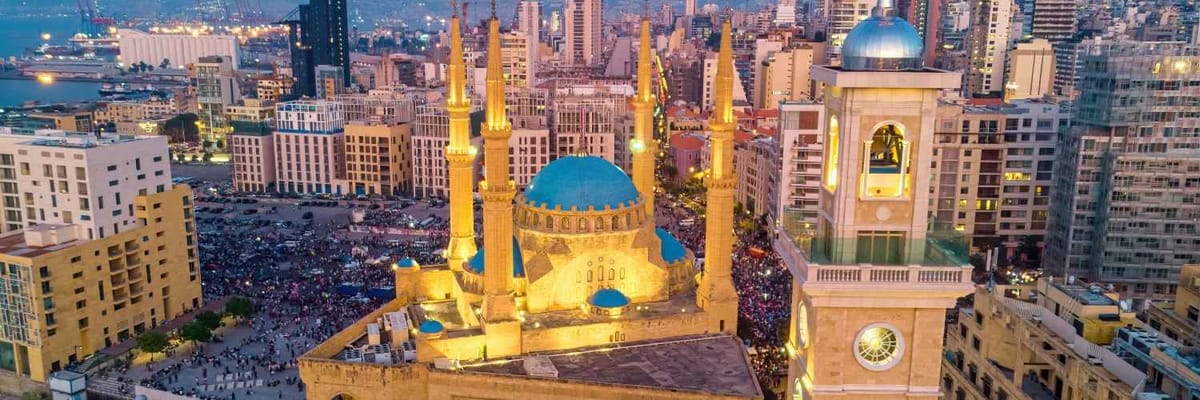
Blue-dome skyline contrasts at Mohammad Al-Amin Mosque, exterior
A bright blue dome and tall minarets stand out against Beirut’s dense downtown skyline. From the surrounding streets and open areas, you can capture a striking contrast between historic-inspired forms and modern city blocks. As light fades, the building’s tones deepen and the scene becomes more cinematic without relying on interiors. Photography rules can change, so keep your shots respectful and follow posted guidance. #HistoricCityVibes #ChasingLight #CinematicTravel
Pine-canopy calm in Horsh Beirut
Tall pines create a surprising green ceiling inside the city, with dappled light that changes every few steps. The long, shaded paths give you natural depth and a softer color palette than Beirut’s coastal brightness. On breezy days, the moving branches add gentle motion to video clips. Access can vary by municipal rules, so confirm current entry conditions before you go. #NatureVibes #MoodyFrames #NatureTextures